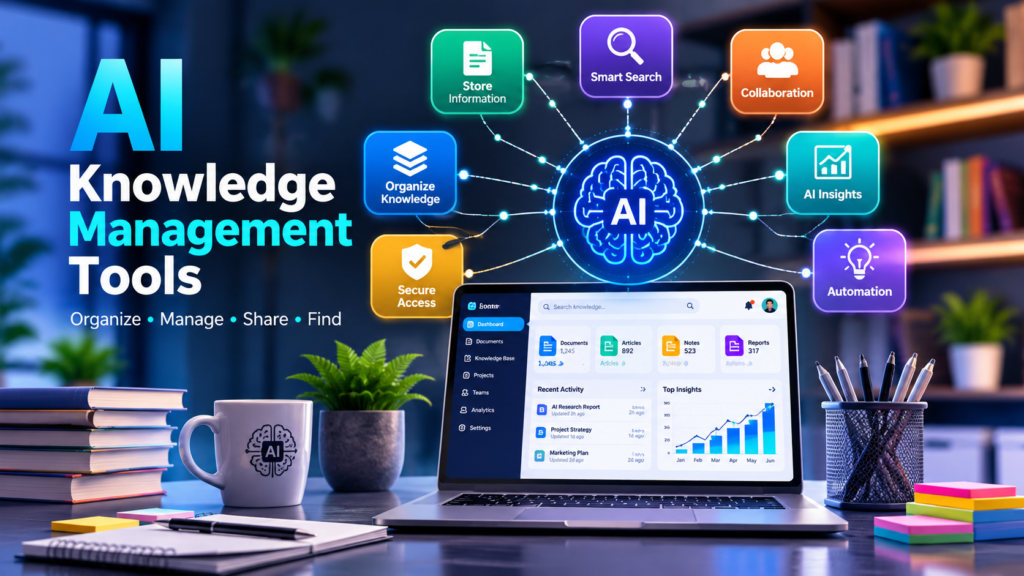
Introduction
As businesses grow, information becomes scattered across emails, documents, chat platforms, cloud storage, and project management tools. Employees often spend valuable time searching for files, policies, meeting notes, and project documentation instead of completing meaningful work.
AI knowledge management tools solve this challenge by organizing business information into a searchable, centralized knowledge base. Using artificial intelligence, these platforms understand context, answer questions, recommend relevant documents, and help teams find the information they need within seconds.
Whether you’re managing a startup, a remote team, or a large enterprise, AI knowledge management software can improve collaboration, reduce duplicated work, and boost productivity.
What Are AI Knowledge Management Tools?
AI knowledge management tools are intelligent platforms designed to collect, organize, search, and manage company knowledge using artificial intelligence. Instead of manually browsing folders or searching through long documents, users can ask natural language questions and receive accurate answers instantly.
These tools can organize information from:
- Internal documentation
- Company policies
- Meeting notes
- Project files
- Training materials
- Customer support guides
- Wikis
- Cloud storage platforms
Many solutions also connect with communication tools and business applications to keep knowledge updated automatically.
How AI Knowledge Management Works
AI-powered knowledge platforms use machine learning and natural language processing (NLP) to understand the meaning behind documents instead of relying only on keyword searches.
They can:
- Index documents automatically
- Summarize lengthy content
- Recommend related resources
- Answer employee questions
- Detect duplicate information
- Organize documents by topic
- Generate knowledge articles
- Improve search accuracy over time
This makes company knowledge easier to access and maintain.
Why Businesses Need AI Knowledge Management
Organizations generate thousands of documents every year. Without a structured knowledge management system, valuable information becomes difficult to locate.
Businesses use AI knowledge management tools to:
- Reduce time spent searching for information.
- Improve employee onboarding.
- Support remote collaboration.
- Keep documentation organized.
- Preserve institutional knowledge.
- Deliver consistent answers across teams.
A centralized knowledge system improves efficiency while reducing repetitive questions.
Benefits of AI Knowledge Management Tools
AI-powered knowledge management platforms provide several important advantages.
Centralize Business Information
Instead of storing documents across multiple systems, AI creates a unified knowledge hub where teams can quickly locate information.
This reduces confusion and improves consistency across departments.
Faster Knowledge Discovery
AI-powered search understands questions written in natural language, allowing users to find relevant answers without remembering exact filenames or keywords.
This significantly reduces time spent searching.
Improve Team Collaboration
When everyone has access to the same up-to-date information, collaboration becomes more efficient.
Teams can share documentation, project updates, and internal resources without creating duplicate files.
Reduce Repetitive Questions
AI assistants answer common employee questions automatically by retrieving relevant information from the company’s knowledge base.
This reduces interruptions for managers and support teams.
Best AI Knowledge Management Tools in 2026
Below are three leading platforms that help organizations organize and manage knowledge more effectively.
Notion AI
Best For: Startups, remote teams, and content-driven organizations.
Notion AI combines note-taking, documentation, databases, and AI-powered writing assistance in one collaborative workspace.
Key Features
- AI document writing
- Smart search
- Meeting notes
- Knowledge databases
- Project documentation
- Team collaboration
Pros
- Clean and intuitive interface.
- Excellent collaboration features.
- Powerful AI writing capabilities.
- Flexible workspace organization.
Cons
- Large workspaces may require careful organization.
Guru
Best For: Customer support, HR, and internal knowledge sharing.
Guru provides an AI-powered knowledge base that delivers verified information directly within employees’ workflows.
Key Features
- AI enterprise search
- Knowledge verification
- Browser extension
- Team collaboration
- Smart recommendations
- Content verification workflows
Pros
- Reliable knowledge verification.
- Easy access inside business applications.
- Strong collaboration tools.
- Helpful AI search capabilities.
Cons
- Premium features are available on higher-tier plans.
Slite AI
Best For: Small businesses and remote teams.
Slite AI helps organizations create, organize, and search documentation while using AI to summarize information and answer questions.
Key Features
- AI document summaries
- Knowledge organization
- Smart search
- Team documentation
- Meeting notes
- Collaborative editing
Pros
- User-friendly interface.
- Fast document creation.
- Excellent for remote teams.
- AI-powered search.
Cons
- Limited advanced enterprise customization.
More of the Best AI Knowledge Management Tools in 2026
As organizations generate more digital information, AI-powered knowledge management platforms are becoming essential for keeping documents organized and easily accessible. Here are three more leading solutions for managing business knowledge in 2026.
Glean
Best For: Medium to large enterprises.
Glean is an AI-powered enterprise search platform that connects with workplace applications and helps employees find documents, emails, conversations, and internal knowledge from a single search interface.
Key Features
- AI-powered enterprise search
- Personalized search results
- Cross-platform indexing
- Natural language queries
- Workplace integrations
- Intelligent recommendations
Pros
- Excellent search accuracy.
- Supports numerous workplace apps.
- Saves employees significant search time.
- Enterprise-ready scalability.
Cons
- Best suited for organizations with large knowledge bases.
Confluence AI
Best For: Software development teams and enterprise collaboration.
Confluence AI enhances Atlassian Confluence with AI-powered writing, document summarization, knowledge discovery, and content recommendations.
Key Features
- AI writing assistance
- Document summaries
- Knowledge organization
- Team collaboration
- Project documentation
- Smart search
Pros
- Ideal for Agile teams.
- Strong documentation features.
- Excellent Atlassian integration.
- AI-powered content assistance.
Cons
- Most valuable for teams already using the Atlassian ecosystem.
Tettra
Best For: Small businesses and growing remote teams.
Tettra helps companies build an internal knowledge base where employees can quickly find answers, organize documentation, and collaborate more efficiently.
Key Features
- Team wiki
- AI-powered search
- Internal documentation
- Knowledge verification
- Slack integration
- Question management
Pros
- Simple setup.
- Easy document organization.
- Great for remote teams.
- Clean user interface.
Cons
- Enterprise-level customization is more limited than some competitors.
How to Choose the Right AI Knowledge Management Tool
Selecting the right platform depends on your organization’s size, collaboration needs, and existing software ecosystem.
Integration Support
Look for tools that connect with the applications your team already uses, such as:
- Google Workspace
- Microsoft 365
- Slack
- Microsoft Teams
- Jira
- Salesforce
- Dropbox
- Google Drive
Strong integrations reduce information silos and improve productivity.
Search Capabilities
An effective AI knowledge management platform should provide:
- Natural language search
- AI-generated answers
- Context-aware recommendations
- Document summaries
- Fast indexing
- Semantic search
These features help employees locate information within seconds.
Collaboration Features
Compare collaboration tools including:
- Shared workspaces
- Document commenting
- Version history
- Permission management
- Knowledge verification
- Team editing
Better collaboration leads to more accurate and up-to-date documentation.
Security and Access Control
Businesses handling sensitive information should prioritize:
- Role-based permissions
- Data encryption
- Audit logs
- Single Sign-On (SSO)
- Compliance certifications
- Backup and recovery
These capabilities protect company knowledge while maintaining accessibility.
AI Knowledge Management vs Traditional Documentation
| Feature | AI Knowledge Management | Traditional Documentation |
| Information Search | ✅ AI-Powered | ❌ Manual Search |
| Content Summaries | ✅ Automatic | ❌ Manual |
| Natural Language Questions | ✅ Supported | ❌ Limited |
| Knowledge Organization | ✅ Intelligent | ⚠ Manual |
| Collaboration | ✅ Real-Time | ⚠ Basic |
| Productivity | High | Moderate |
AI knowledge management systems make finding, organizing, and sharing business information much faster than traditional documentation methods.
Best Practices for Using AI Knowledge Management Tools
To maximize the value of your knowledge platform:
- Keep documentation updated regularly.
- Organize content using clear categories.
- Remove outdated or duplicate information.
- Define user permissions carefully.
- Encourage employees to contribute knowledge.
- Review AI-generated summaries before publishing.
Maintaining a clean and accurate knowledge base improves both employee productivity and decision-making.
Conclusion
AI knowledge management tools are transforming how businesses capture, organize, and share information. By combining intelligent search, document organization, AI-generated summaries, and collaborative workspaces, these platforms help teams find the right information faster and work more efficiently.
Whether you choose Notion AI, Guru, Slite AI, Glean, Confluence AI, or Tettra, the ideal solution depends on your organization’s size, collaboration style, and existing software stack. Investing in AI-powered knowledge management can improve productivity, accelerate onboarding, and preserve valuable organizational knowledge.
Frequently Asked Questions
What are AI knowledge management tools?
AI knowledge management tools use artificial intelligence to organize, search, summarize, and retrieve business information more efficiently.
Can AI replace traditional company wikis?
AI enhances traditional wikis by providing intelligent search, automatic summaries, and natural language question answering, but organizations still need well-maintained documentation.
Which AI knowledge management tool is best for small businesses?
Notion AI, Slite AI, and Tettra are excellent choices for startups and small teams because they are easy to use and support collaborative documentation.
Are AI knowledge management tools secure?
Most enterprise platforms offer encryption, access controls, audit logs, and compliance features to help protect sensitive business information.
How do AI knowledge management tools improve productivity?
They reduce time spent searching for information, eliminate duplicate documentation, improve collaboration, and provide quick answers through AI-powered search.