Introduction
Managing customer relationships has become more complex as businesses interact with customers across email, social media, live chat, websites, and phone calls. Traditional CRM systems help organize customer information, but AI CRM tools take customer relationship management to the next level by automating tasks, analyzing customer behavior, and providing intelligent recommendations.
From predicting sales opportunities to automating follow-up emails and summarizing customer conversations, AI CRM software helps sales and marketing teams work smarter instead of harder. Whether you’re a startup, small business, or large enterprise, adopting an AI-powered CRM can improve efficiency, increase conversions, and strengthen customer relationships.
What Are AI CRM Tools?
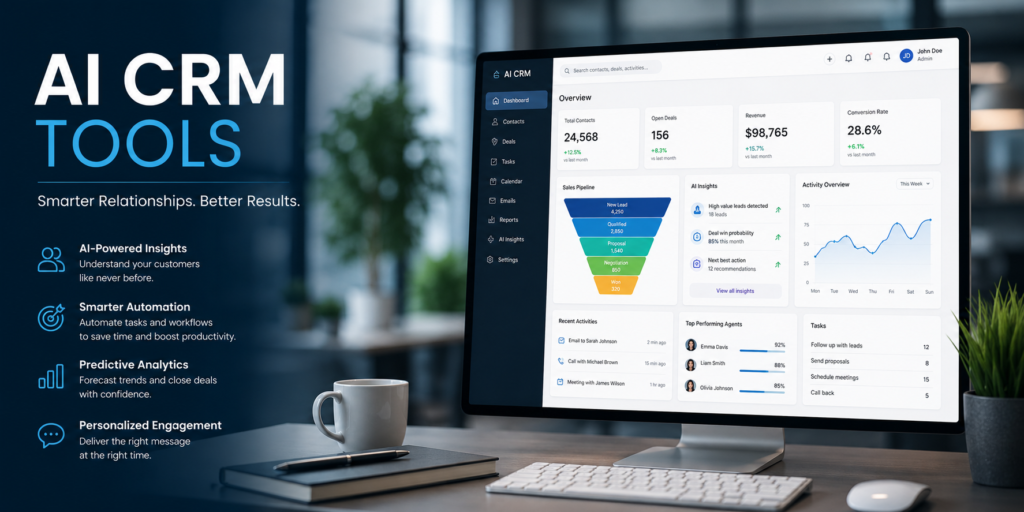
AI CRM tools are customer relationship management platforms enhanced with artificial intelligence. They use machine learning, predictive analytics, and natural language processing to automate repetitive tasks, provide sales insights, and improve customer engagement.
These platforms help businesses:
- Manage leads
- Track customer interactions
- Automate follow-ups
- Predict sales outcomes
- Score leads automatically
- Generate sales insights
- Summarize meetings and emails
- Improve customer retention
Unlike traditional CRM systems, AI-powered CRMs continuously learn from customer data to deliver smarter recommendations and automation.
How AI Improves CRM Systems
Artificial intelligence transforms CRM software by reducing manual work and providing actionable insights.
AI can:
- Predict which leads are most likely to convert.
- Recommend the next best sales action.
- Generate personalized email responses.
- Detect customer sentiment.
- Identify upselling opportunities.
- Automate routine administrative tasks.
- Create meeting summaries.
- Analyze customer engagement trends.
These capabilities allow sales teams to focus more on building relationships and closing deals.
Why Businesses Are Adopting AI CRM
Companies are investing in AI CRM tools because they help improve both sales performance and customer satisfaction.
Businesses use AI CRM software to:
- Increase sales productivity.
- Improve lead qualification.
- Personalize customer communication.
- Reduce administrative workload.
- Strengthen customer relationships.
- Generate accurate sales forecasts.
As AI technology continues to advance, CRM platforms are becoming more intelligent and proactive.
Benefits of AI CRM Tools
Modern AI CRM platforms offer several advantages for sales and customer success teams.
Better Lead Management
AI automatically analyzes customer data and assigns lead scores based on purchase intent, engagement history, and behavioral patterns.
This helps sales representatives prioritize high-value opportunities.
Smarter Sales Forecasting
AI analyzes historical sales data, pipeline activity, and customer behavior to predict future sales performance with greater accuracy.
These insights help managers make informed business decisions.
Automated Customer Engagement
AI CRM systems can automatically send personalized follow-up emails, reminders, appointment confirmations, and marketing messages.
Automation ensures consistent communication throughout the customer journey.
Increased Team Productivity
By handling repetitive tasks like data entry, scheduling, and note-taking, AI allows sales teams to spend more time selling and less time on administration.
This improves overall productivity and efficiency.
Best AI CRM Tools in 2026
Below are three leading AI-powered CRM platforms helping businesses streamline sales and customer management.
Salesforce Einstein
Best For: Large enterprises and growing sales organizations.
Salesforce Einstein adds powerful AI capabilities to Salesforce CRM, helping businesses automate workflows, predict sales opportunities, and improve customer engagement.
Key Features
- Predictive lead scoring
- AI sales forecasting
- Opportunity insights
- Email recommendations
- Customer behavior analysis
- Workflow automation
Pros
- Industry-leading AI capabilities.
- Enterprise-grade scalability.
- Deep analytics and reporting.
- Extensive integration ecosystem.
Cons
- Premium features may require higher-tier Salesforce plans.
HubSpot AI
Best For: Small and medium-sized businesses.
HubSpot AI enhances CRM workflows with AI-generated content, sales assistance, automated email drafting, and customer insights.
Key Features
- AI email generation
- Meeting summaries
- Contact intelligence
- Sales recommendations
- CRM automation
- Marketing integration
Pros
- User-friendly interface.
- Excellent marketing integration.
- Strong automation features.
- Ideal for growing businesses.
Cons
- Advanced AI functionality varies by subscription plan.
Zoho CRM with Zia
Best For: Budget-conscious businesses and SMBs.
Zoho CRM includes Zia, an AI assistant that provides sales predictions, anomaly detection, workflow suggestions, and intelligent automation.
Key Features
- AI sales assistant
- Predictive analytics
- Workflow automation
- Lead scoring
- Voice assistance
- Customer insights
Pros
- Affordable pricing.
- Comprehensive CRM features.
- Helpful AI assistant.
- Easy customization.
Cons
- Some advanced AI capabilities require premium editions.
More of the Best AI CRM Tools in 2026
AI-powered CRM platforms continue to evolve with predictive analytics, intelligent automation, and generative AI assistants. Here are three more leading AI CRM solutions that help businesses strengthen customer relationships and accelerate sales.
Microsoft Dynamics 365 Copilot
Best For: Enterprises using the Microsoft ecosystem.
Microsoft Dynamics 365 Copilot integrates generative AI directly into CRM workflows, helping sales teams draft emails, summarize meetings, analyze customer interactions, and automate administrative tasks.
Key Features
- AI sales assistant
- Meeting summaries
- Automated email drafting
- Sales insights
- Customer analytics
- Microsoft 365 integration
Pros
- Deep Microsoft integration.
- Excellent AI productivity features.
- Enterprise-grade security.
- Advanced business analytics.
Cons
- Best suited for businesses already invested in Microsoft products.
Freshsales AI
Best For: Small and medium-sized businesses.
Freshsales AI, powered by Freddy AI, helps businesses manage leads, predict sales outcomes, automate follow-ups, and improve customer engagement through intelligent recommendations.
Key Features
- AI lead scoring
- Sales forecasting
- Contact insights
- Workflow automation
- Email tracking
- AI recommendations
Pros
- Easy-to-use interface.
- Affordable pricing.
- Strong automation features.
- Fast implementation.
Cons
- Advanced reporting options are limited compared to some enterprise CRM platforms.
Pipedrive AI
Best For: Sales-focused teams.
Pipedrive AI provides intelligent sales recommendations, deal prioritization, pipeline analysis, and automated reminders that help sales representatives close deals more efficiently.
Key Features
- AI deal insights
- Pipeline management
- Sales assistant
- Activity reminders
- Revenue forecasting
- Workflow automation
Pros
- Excellent sales pipeline visualization.
- Easy learning curve.
- Helpful AI assistant.
- Ideal for sales teams.
Cons
- Marketing automation features are less extensive than some competitors.
How to Choose the Right AI CRM Tool
Choosing the right AI CRM depends on your business goals, team size, and existing technology stack.
AI Features
Look for capabilities such as:
- Predictive lead scoring
- AI-generated emails
- Sales forecasting
- Customer sentiment analysis
- Meeting summaries
- Workflow automation
- Intelligent recommendations
These features help sales teams work more efficiently and close deals faster.
Integration Options
Your CRM should integrate smoothly with tools such as:
- Email platforms
- Marketing software
- Customer support systems
- Accounting software
- Project management tools
- Communication platforms
Good integrations reduce manual work and improve data accuracy.
Ease of Use
A CRM should be simple enough for your team to adopt quickly.
Look for:
- Clean dashboards
- Customizable pipelines
- Drag-and-drop workflow builders
- Mobile applications
- Easy reporting
Higher adoption leads to better business outcomes.
Scalability
As your business grows, your CRM should support:
- Additional users
- More customer records
- Advanced automation
- Enterprise security
- Custom reporting
- API integrations
Selecting a scalable platform avoids costly migrations later.
AI CRM vs Traditional CRM
| Feature | AI CRM | Traditional CRM |
| Lead Scoring | ✅ AI-Powered | ❌ Manual |
| Sales Forecasting | ✅ Predictive | ⚠ Limited |
| Workflow Automation | ✅ Advanced | ⚠ Basic |
| Email Assistance | ✅ AI Generated | ❌ Manual |
| Customer Insights | ✅ Intelligent | ⚠ Basic Analytics |
| Productivity | High | Moderate |
AI CRM platforms automate repetitive tasks while providing valuable insights that help businesses improve sales performance and customer relationships.
Best Practices for Using AI CRM Tools
To get the best results:
- Keep customer data accurate and updated.
- Automate repetitive workflows gradually.
- Review AI-generated recommendations before acting.
- Train your sales team on AI features.
- Monitor CRM performance regularly.
- Continuously refine sales pipelines.
Combining AI automation with strong sales processes delivers the highest return on investment.
Conclusion
AI CRM tools are reshaping customer relationship management by combining automation, predictive analytics, and generative AI into one intelligent platform. These solutions help businesses manage leads more effectively, strengthen customer relationships, automate routine tasks, and improve sales performance.
Whether you choose Salesforce Einstein, HubSpot AI, Zoho CRM with Zia, Microsoft Dynamics 365 Copilot, Freshsales AI, or Pipedrive AI, selecting the right platform depends on your organization’s size, sales process, and integration requirements. Investing in AI-powered CRM software can help your team work smarter, close more deals, and deliver a better customer experience.
Frequently Asked Questions
What are AI CRM tools?
AI CRM tools use artificial intelligence to automate customer relationship management, improve lead management, generate sales insights, and increase team productivity.
Can AI improve sales performance?
Yes. AI helps businesses identify high-quality leads, automate follow-ups, predict customer behavior, and recommend the next best sales actions.
Which AI CRM is best for small businesses?
HubSpot AI, Freshsales AI, and Zoho CRM with Zia are excellent options because they combine affordability with powerful AI features.
Are AI CRM tools secure?
Leading AI CRM platforms provide enterprise-grade security, encryption, role-based access controls, and compliance features to protect customer information.
Do AI CRM tools require technical expertise?
No. Most modern AI CRM platforms offer intuitive interfaces, guided setup, and no-code automation features suitable for businesses of all sizes.